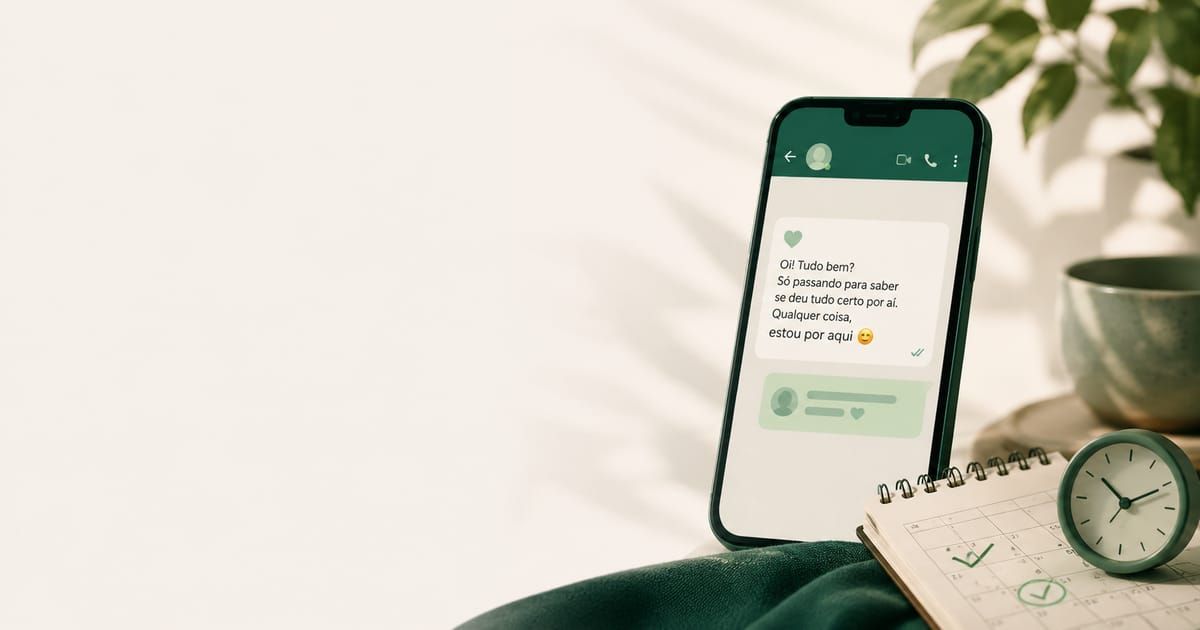
Straight to the point
A good WhatsApp follow-up is not nagging, it is a useful reminder. The cadence that works for small businesses is usually 3 to 4 spaced touches (same day, in 2 to 3 days, then after a week), each bringing something new: a piece of information, an easier option, a direct question. A message that repeats “so, are you taking it?” reads as spam. A message that helps the customer decide does not.
Why follow-up stalls (and the sale slips)
Almost no one loses a sale from not knowing how to sell. They lose it from not coming back at the right time. The customer asked, you answered, and the conversation simply died: they got distracted, compared, forgot. Without a reminder to pick it back up, the sale cools on its own. This is one of the points where sales leak, as we show in how to stop losing sales on WhatsApp.
The cadence that does not turn into chasing
The rule is simple: space the touches and give each one a reason. A sequence that works for most small businesses:
- Touch 1, same day: confirm you understood the request and state the next step.
- Touch 2, in 2 to 3 days: bring something new (a condition, a common question answered, an easier option).
- Touch 3, around a week later: a direct question that is easy to answer.
- Touch 4, the last one: leave the door open and stop. Pushing past this only burns the contact.
The secret is not the quantity, it is the spacing and the reason. Four useful messages over two weeks do not bother anyone. Four “hey, are you there?” in the same day do.
Ready-made templates to copy and adapt
Use these as a starting point and adjust for your voice and your customer. Replace the parts in brackets.
Touch 1, same-day confirmation
Hi [name]! I have your request for [item/service] noted. The next step is [action]. I will send you [what] later today, sound good?
Touch 2, bringing something new
[name], you came to mind. [New information or condition, e.g. we can get a slot this week.] Does it still make sense to go ahead with [item/service]?
Touch 3, direct question
Hi [name]! So I am not leaving you waiting: does [item/service] still make sense, or would you rather I pause for now?
Touch 4, door open and stop
All good, [name]. I will pause here so I am not crowding you. Whenever you want to pick it back up, just message me and I will continue where we left off.
What makes a follow-up read as spam
Avoid these mistakes, which turn a reminder into a nuisance:
- Repeating the same message. If the touch brings nothing new, it becomes noise.
- Sending everything the same day. Too much pressure scares people off.
- Not personalizing. “Dear customer” on WhatsApp sounds like a robot.
- Never stopping. A fourth touch with no reply is the time to close gracefully.
Why getting organized helps follow-up
A good template is useless if you do not remember who needs a follow-up or which touch each person is on. When conversation and status live in the same place, you can see who paused, at what point, and pick it back up with the history alongside, without re-reading everything. That is what Briva does: WhatsApp support and a lightweight CRM together, so you do not forget anyone. See it on the home page.
Frequently asked questions
How many times can I follow up without annoying people? Usually 3 to 4 well-spaced touches over one or two weeks. What annoys people is not the quantity, it is high frequency and a lack of reason in each message.
What is the best interval between messages? Start the same day, come back in 2 to 3 days, then around a week later. Adjust to your type of sale: a quick purchase calls for shorter intervals, a big decision calls for more space.
Can I automate WhatsApp follow-up? You can use ready-made templates and reminders so you do not forget. Even so, review each message before sending: the follow-up that works sounds personal, not automatic.
What if the customer answers none of the touches? Close gracefully on the last touch and leave the door open. Pushing past that usually burns the contact instead of recovering the sale.
Written by the Briva Team, who built the tool after living through this chaos firsthand.