Straight to the point
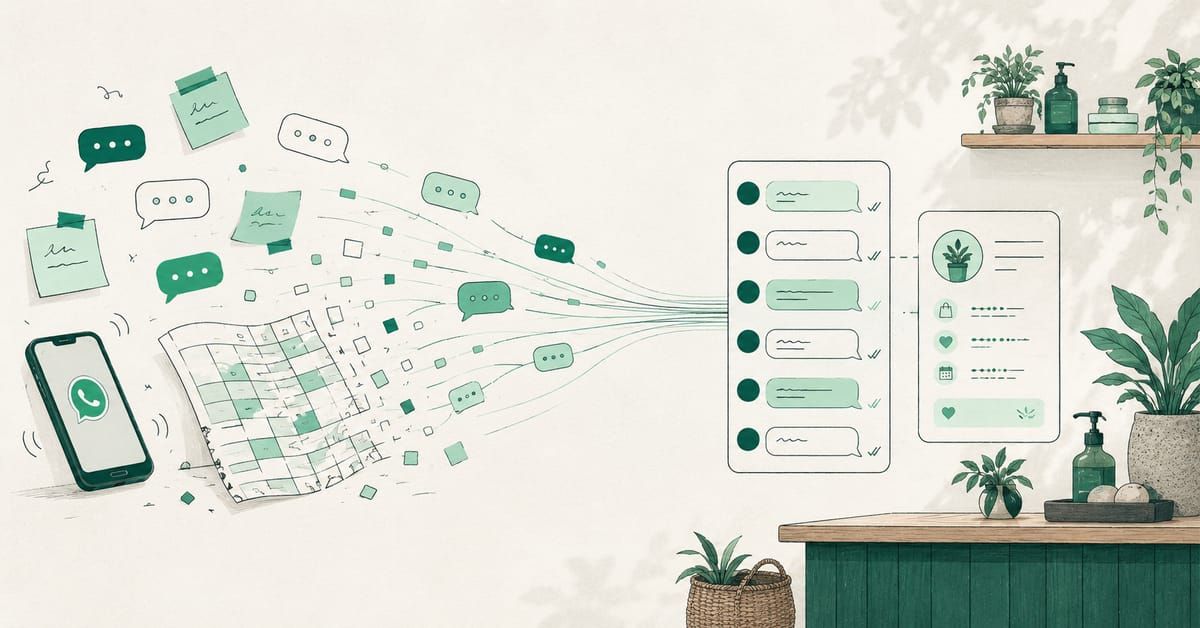
When your conversations live in your personal WhatsApp and the status sits in a spreadsheet, sales slip through three gaps: you are slow to reply, your team asks again what the customer already answered, and returning customers are treated like new ones. The fix is not a heavy CRM: it is bringing conversations and history into one place that anyone on the team can pick up.
One message, one day offline, one fewer customer
A customer sent a message. I had no internet access at that moment. By the time I got back, they had already closed with a competitor. Not because of price, but because I never replied. The part that stings: if anyone on the team could have opened that conversation and continued it, with the customer’s history right there, the sale would not have been lost. But the conversation was locked in my personal WhatsApp. Only me.
The problem is not a missing CRM. It is you becoming the bottleneck.
Almost every small business owner starts the fastest way: answer everything on WhatsApp, keep the rest in your head. It works until you have a team. Then comes the question that stalls growth: “why can no one serve customers the way I do?” The answer is simple: there was never a process. The knowledge is inside you. And a business where everything depends on the owner does not grow: the owner becomes an employee of their own company.
The common reaction is “then I will get a CRM.” But a traditional CRM is powerful and complex: expensive, full of fields, built for large sales teams. For someone working alone or with two or three people, it becomes a barrier: no one fills it in, and within three weeks it sits abandoned.
The 3 places where sales leak
- Response time. On WhatsApp, customers expect a fast reply. If it depends on one person, any absence (a meeting, lunch, no internet) puts a sale at risk.
- Asking again what the customer already answered. Without history at hand, your team repeats questions the customer already answered. Each time, they feel they are starting from zero, and trust drops.
- Treating a returning customer like a new one. Without history in view, every contact becomes “first time.” Gone is the “remember when you mentioned…” that closes the deal.
What it looks like when organized
It is not more tools. It is fewer gaps between them:
- All messages in one place (official and unofficial WhatsApp), with the customer’s history right alongside.
- Transferable service with history included. Anyone on the team picks up where the last person left off, with no “can someone fill me in?”.
- History stays with the business. If someone leaves the team, the data and conversations stay in the tool. They do not walk out on someone’s phone, or go to a competitor.
That is what Briva does: customer service and a lightweight CRM in the same place, built for businesses that serve customers directly, not for teams with an IT department.
Frequently asked questions
It is just me, why would I need a tool? It works right up until you have a team, or until you are offline for a day. Getting organized early is what lets you delegate later without becoming the bottleneck.
Does WhatsApp Business not solve it? It centralizes messages on the device, but the conversation stays locked there and disappears when you are not around. It is not transferable with history.
Is a CRM not too complicated? The traditional kind, yes. The idea here is the opposite: light enough to use every day, no consultant required.
What about when I hire someone? That is when the organization pays off: the person joins and continues conversations with full context, instead of starting from scratch.
Written by the Briva Team, who built the tool after living through this chaos firsthand.